











Nigeria and South Africa sit at the top of the latest YouGov results on stablecoin ownership, and that headline is accurate but incomplete. In the Stablecoin Utility Report 2026 (commissioned by BVNK with Coinbase and Artemis), YouGov surveyed 4,658 adults (18+) across 15 countries via an online panel in September–October 2025. The sample was not the general public: it targeted people who currently hold crypto, held it in the past 12 months, or intend to buy in the next 12 months, a “crypto-active” group.
What the YouGov Survey Actually Found on Africa
The Stablecoin Adoption survey was commissioned by payments infrastructure provider BVNK, in partnership with Coinbase and Artemis, and conducted by YouGov between September and October 2025. It sampled 4,658 adults aged 18 and older across 15 countries on five continents. Critically, the sampling frame focused exclusively on current crypto holders, those who held crypto in the prior 12 months, or high-intent prospective owners.
Within that population, Africa’s two measured markets ranked highest globally for stablecoin ownership: Nigeria and South Africa recorded a combined 79% current or recent stablecoin ownership rate, plus the strongest “forward intent” to grow holdings (76%). Nigeria was the standout: 87% ownership and 80% intent to increase holdings in 2026, versus 70% and 72% in South Africa.
The Massive Surge of Stablecoin Adoption as a Remittance Lifeline for Sub Saharan Africa
One demographic finding stands out globally: while stablecoin ownership skews male at 60% worldwide, Nigerian and South African women represent 51% of users, equal to men. In environments defined by currency volatility and limited banking access, stablecoins are household tools, not hobbies.
The Stablecoin Adoption Story Is Wider Than Nigeria and South Africa
The YouGov data captures two markets. The on-chain reality captures a continent.
According to Chainalysis, Sub-Saharan Africa received over $205 billion in on-chain value between July 2024 and June 2025, a 52% year-over-year increase, making it the third fastest-growing crypto region globally. Stablecoins account for approximately 43–45% of all digital asset transaction volume in the region, per Yellow Card’s 2026 reporting. That ratio defines a utility-led market, not a speculative one.
RELATED: The 2026 Borderless Report on Africa’s Global Execution Spread Premium
Country-level signals reinforce this breadth:
- Ethiopia recorded 180% year-over-year growth in retail crypto transfers under $10,000 in 2025—the fastest-growing retail market on the continent—driven partly by a 30% local currency devaluation.
- Kenya ranks 5th globally for transactional stablecoin use, underpinned by M-Pesa’s 34 million users providing a mature mobile money gateway.
- Ghana has an estimated 3 million stablecoin users and is running central bank sandbox projects focused on blockchain-based remittances, following passage of its Virtual Asset Service Providers Act in late 2025.
- Uganda records top-five Sub-Saharan Africa inflows alongside Kenya.
- In Francophone West Africa, Senegal and Côte d’Ivoire are seeing stablecoins used to navigate constraints of the CFA franc in regional trade settlement.
Why Crypto Payments Are Becoming Everyday Essentials (Bitget Report)
TRM Labs places Egypt and Nigeria in the global top 20 on its adoption index, with North Africa accelerating separately. The IMF estimates stablecoin flows reached 6.7% of Africa’s continental GDP in 2024.
Why do Africans prefer stablecoins over local currencies? The “operating rails” explanation
The BVNK survey found that 92% of African respondents said national economic conditions directly influence their stablecoin usage. That figure explains everything.
Why do Africans prefer stablecoins over local currencies? Nigeria, Ethiopia, and Egypt all experienced currency devaluations of 20–50% in 2025. Holding working capital in naira, birr, or pounds during that period was a direct threat to business solvency. Stablecoins, pegged to the U.S. dollar, provide what local bank accounts cannot: stable purchasing power, accessible 24/7, without capital controls.
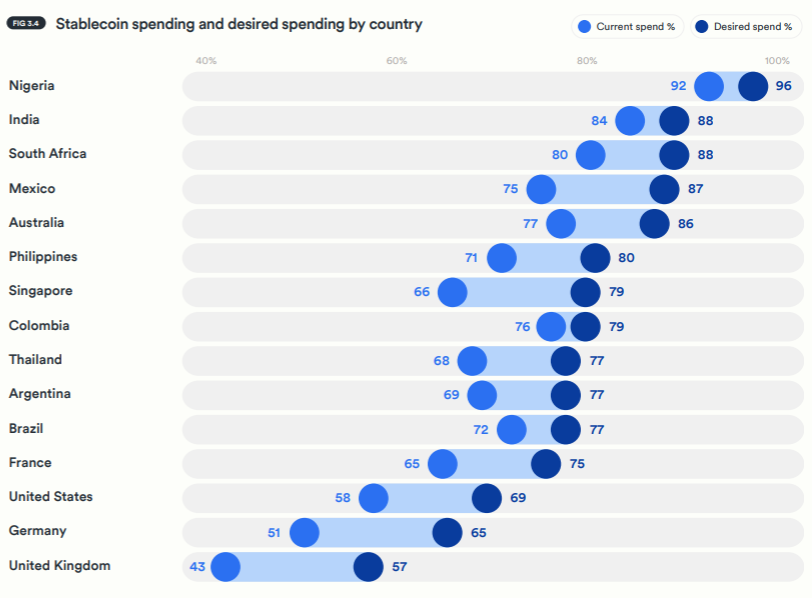
The cost case is equally concrete. World Bank Q1 2025 data shows the average cost of sending $200 to Sub-Saharan Africa is 8.78%, the most expensive remittance corridor globally. For a business operating on a 5% margin, a 3% transfer fee combined with a 2% currency swing during a five-day settlement window eliminates all profit. Respondents in the BVNK survey reported self-estimated fee savings of 40–60% on cross-border transfers using stablecoins.
RELATED: CBN Fintech Report Shows Massive 70% Growth In Nigeria Sector
As John Turner, Product Lead at BVNK, summarizes;
“In many emerging economies, people have adopted stablecoins out of necessity.”
How Stablecoins Are Used Operationally
Crypto payroll and the gig economy
Among those receiving any crypto income, approximately 35% of annual earnings now arrive in stablecoins. Roughly three-quarters say stablecoin income has increased their ability to do business internationally. Employers avoid local payroll compliance complexity; workers receive instant access to dollar-denominated value.
B2B trade settlement
African importers are increasingly paying Chinese manufacturers in USDT, bypassing multi-day New York clearing-bank reconciliations. China-Africa trade grew significantly in 2025, and Chainalysis confirms stablecoins appear in high-value transfers tied to these flows.
Treasury and liquidity management
Pan-African fintechs like Onafriq hold value on-chain in USDC and on-ramp to local fiat only at the point of disbursement, eliminating “trapped capital” in volatile local currencies across 40+ markets.
Remittances
The sender acquires USDT or USDC and transfers it near-instantly to a recipient wallet, who can hold dollar-denominated value or off-ramp locally, compressing multi-day delays to hours.
Stablecoin-linked debit cards
89% of African respondents expressed interest in using a stablecoin-linked debit card, the highest globally. Providers like Chipper Cash allow users to fund virtual cards with stablecoins, enabling purchases from global platforms that frequently reject African bank cards due to FX restrictions. Spending on Visa-linked crypto cards surged 525% year-over-year by late 2025.
RELATED: The 2026 Borderless Report on Africa’s Global Execution Spread Premium
What This Means for Traders, Businesses, and Policymakers
For African SMEs, traders, and fintech operators, the 2025–2026 evidence points to one practical conclusion: stablecoins are increasingly treated as financial plumbing, not a trend.
If you’re evaluating stablecoin payments in 2026, key decision points are:
- Map the exact corridor (trade, remittance, contractor pay) and model total cost, including on/off-ramp spreads, not just chain fees.
- Choose rails based on recipients’ reality (many corridors default to TRC-20 USDT; some retail apps push low-fee networks).
- Design for compliance early as licensing regimes tighten (South Africa, Kenya, and Nigeria are moving toward more formalized supervision).
Nigeria and South Africa lead the YouGov ownership headline for a reason: they sit at the intersection of FX friction, high digital finance literacy, and fast-growing cross-border commerce. But the most “helpful” interpretation of the report is broader: Africa’s practical stablecoin curve is already being written across multiple markets, and 2026 is where that utility story starts to look like default infrastructure.
Discover more from Web3Africa
Subscribe to get the latest posts sent to your email.
You must be logged in to post a comment.