










TL:DR,
- Nigeria has skyrocketed to 3rd place globally for new Web3 developer growth, adding over 16,000 developers to the Ethereum ecosystem alone and now accounting for half of all Web3 talent in Africa.
- Locally built training pipelines (Web3Bridge, Web3Ladies, Semicolon, AyaHQ) rapidly produce industry-ready talent across EVM, Rust, and Move.
- While opportunities are booming, most Nigerian developers work as freelancers, earn below the global average, and find that multi-chain expertise is essential for securing top-tier blockchain developer jobs.
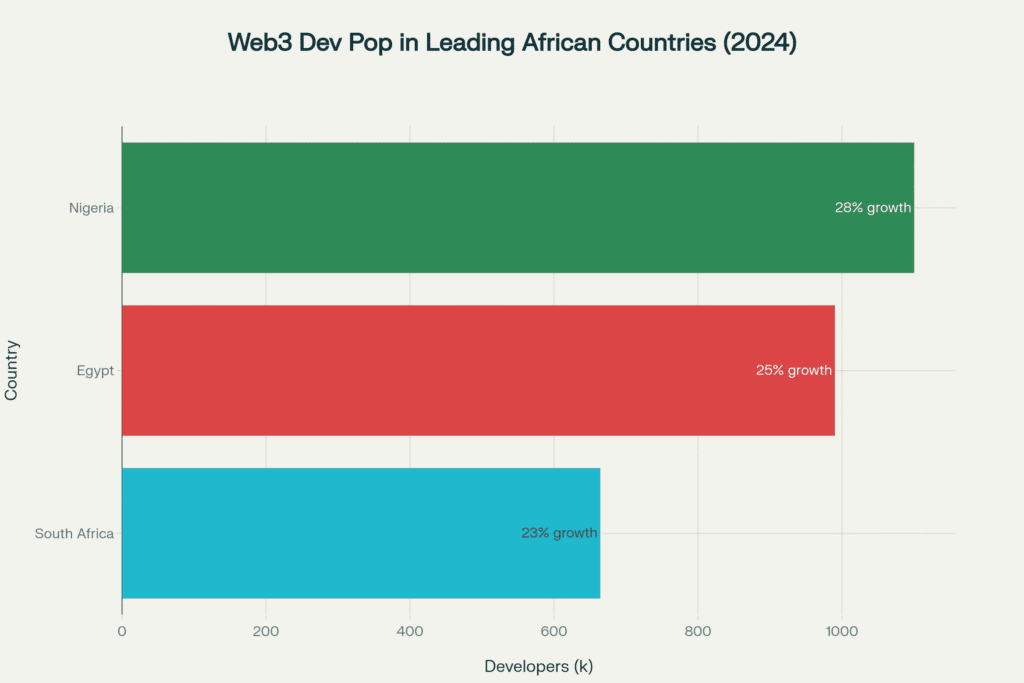
Ten years ago, Nigeria was hardly visible on the global blockchain landscape. Fast forward to 2025, and the West African nation has catapulted to third place globally for new Web3 developer growth. According to the Electric Capital Report, Nigeria has had over 16,000 developers joining the Ethereum ecosystem since January.
The state now commands 3.8% of total contributors and 2.9% of full-time talent. While this figure does appear minute, within Africa, that’s half of all Web3 developers. Here’s an insight into how Nigeria dominates.
Nigeria Emerges as Global Web3 Developer Powerhouse
The numbers generally tell a story of acceleration. Electric Capital’s methodology is robust, analyzing 902 million code commits across 1.7 million repositories and distinguishing between new, emerging, and established contributors. The company’s research, which analyzed activity from January through September 2025, revealed that over 16,000 developers joined the Ethereum ecosystem during this period, followed by substantial growth in Solana and Bitcoin communities.
Ethereum still maintains the largest active developer base with 31,869 contributors, while Solana has grown to 17,708 and Bitcoin holds steady at 11,036. In terms of overall developer share, Nigeria is now on par with the UK, Germany, China, and Canada, and it surpasses France, Brazil, and Spain.
CHECK OUT: Bybit, Tether Roll Out $3,000 CSR Scholarship to Support Education in South Africa
It’s a reminder of how Africa has moved from consuming Web3 products to developing local solutions. This fact is actively seen with many exosystems like Lisk and Base pioneering hackathons, grants, and education platforms. Nigeria specifically matches the contributions of China, Poland, and Spain in full-time Web3 developer positions.
Africa collectively constitutes 6.6% of the global Web3 developer population, with Asia leading the way with 43.5% of new developers and 33.2% of the overall total. However, what distinguished the Africa developer community is the rate of change. For instance, Nigeria had virtually negligible figures, some attributing it to zero in 2025 to standing toe-to-toe with first-world economies.
Blockchain Training Infrastructure That Placed Nigeria on Top
How did Nigeria manage to develop this ecosystem so swiftly? The answer lies in a robust network of locally driven blockchain training initiatives that emerged over the past six years.
Blockchain training has become a sought-after and lucrative venture within Africa. In the past decade these platforms have successfully aided Nigeria in placing it at the top of the food chain.
Web3Bridge: Producing Industry-Ready Developers
Web3Bridge, a common name within the site, has trained over 3,000 participants, with 880+ completing its rigorous Web3 program since 2019. Its blockchain training platform offers a comprehensive 16-week curriculum covering Solidity, EtherJS, Web3JS, Hardhat, Foundry, NFTs, zero-knowledge proofs, and blockchain security.
Web3Ladies: Changing the Gender Dynamic
Considered the first female blockchain engineer, Oluchi Enebeli founded Web3Ladies as a means to bridge the gender gap in Web3. Currently the platform has more than 15,000 members across Africa and has contributed to female participation rising to 17% among Nigerian Web3 developers in the past 3 years. Their approach to blockchain training mainly focuses on community workshops, mentorship programs, and creating supportive networks focused mainly on women.
[inline_related_posts title=”Thought you’d enjoy this” title_align=”left” style=”grid” number=”6″ align=”none” ids=”” by=”primary_cat” orderby=”rand” order=”DESC” hide_thumb=”no” thumb_right=”no” views=”no” date=”no” grid_columns=”2″ post_type=”” tax=””]
Semicolon Africa (Nigeria)
While Semicolon doesn’t specifically focus on blockchain training, the platform has made considerable contributions. Backed by a $1.3 million endowment, Semicolon advances training in Move (Sui/Aptos) and smart contracts, pairing instruction with loans (~₦5 million at 12% annual interest) that recycle repayments to finance new students.
It’s among the main pipelines for any Web3 developer to secure a job within the Sui ecosystem.
AyaHQ: Combining Incubation with Education
AyaHQ establishes physical talent hubs in Accra and Kilifi, which have trained over 100+ African developers and serve as collaborative spaces for building decentralized solutions. Further solidifying its impact, AyaHQ runs structured programs like the 8-week Velocit8 incubation program, which accelerated startups to produce 12 viable MVPs. The platform has expanded beyond Nigeria, partnering with institutes like Ghana Communication Technology University and Women in Blockchain Africa.
Additional mentions of contributing to the rising African developer community include:
- Africa Blockchain Center (Kenya): In partnership with IOG, it runs Haskell/Plutus/Marlowe training for Cardano development via blended learning.
- Blockchain Academy (South Africa): Operating since 2015, it delivers enterprise courses across Bitcoin, Ethereum, and Hyperledger in seven African countries.
- Africa Blockchain Institute (Rwanda): Four-month startup incubations combine technical education, business design, and investor access, culminating in Demo Days.
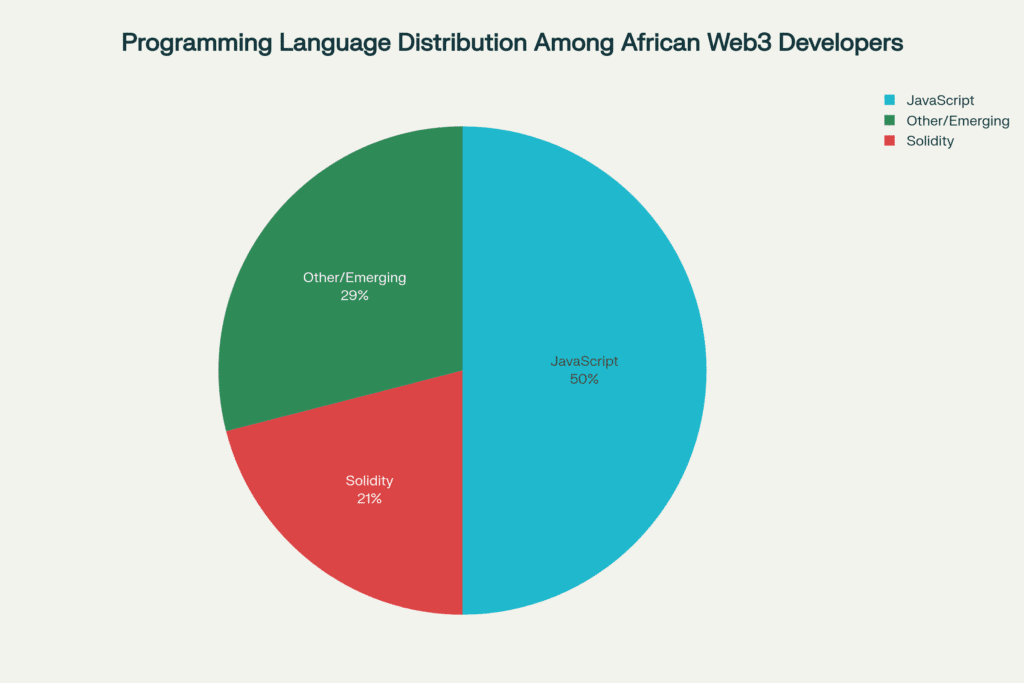
This network of programs grows the Africa developer community and shapes technical preferences. JavaScript is the most popular (50%), followed by Solidity (21%), and TypeScript is used a lot on the front end. Emerging stacks like Rust (Solana/NEAR/Polkadot), Cairo (StarkNet), and Move (Sui/Aptos) are becoming more popular as grants and accelerators encourage more advanced research and, yes, more blockchain training.
Where Developers Are Building
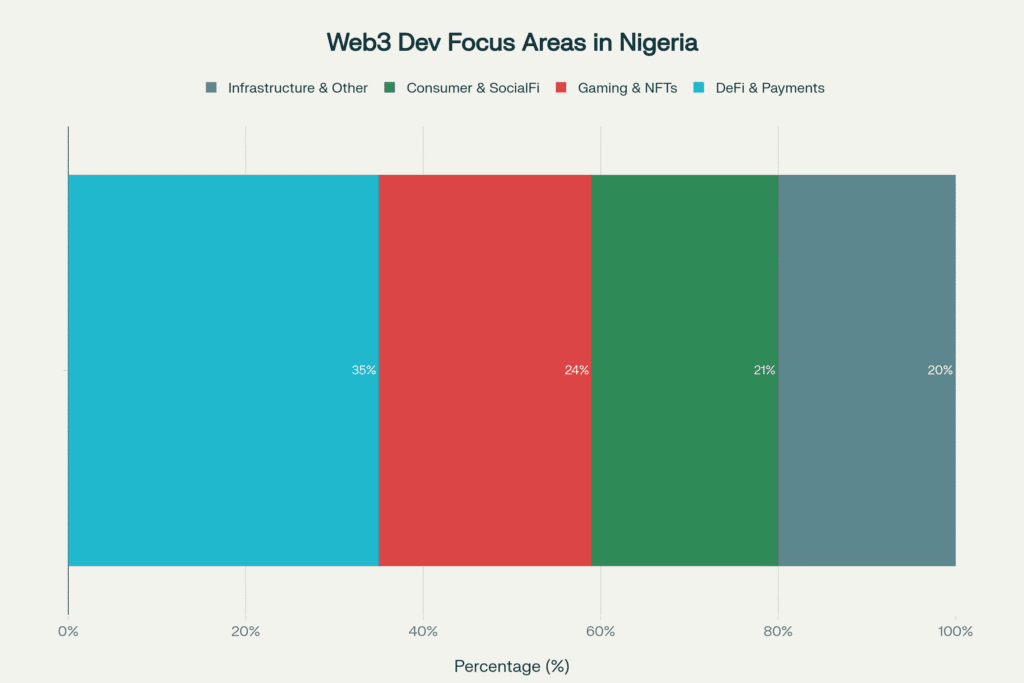
While blockchain does have its fair share of applications in health, agriculture, AI, and even government, its main impact is in finance and recently in stablecoin payments. Nigeria, as always, stands at the top of the trading stats. In Q1 2024 alone, stablecoin transfers reached $3 billion, and the USDT/NGN pair ranks among the most traded on centralized exchanges.
For most Nigerians, stablecoins are a means for compensation, with 45% of Nigerian developers receiving payments in stablecoins, a response to local currency volatility. Projects like Ribh Finance and Azza (remittances on Solana), Swypt (payment rails), and ElementPay (everyday crypto-fiat payments) show how mission-driven builders in the Africa developer community are turning friction into solutions.
Gaming and NFTs attract 24% of developers, while consumer and SocialFi applications engage 21%. It’s more about an attempt to solve an issue rather than taking advantage of a new market. When thinking about stablecoin payments, developers have gone as far as providing infrastructure; BlockRadar is among such innovative looks.
The Truth About Web3 Careers in Nigeria
According to the finding, more blockchain developer jobs are rising with more demand. Only 15% of Nigerian Web3 developers hold full-time positions, with most operating as freelancers. Nigeria’s growth means more jobs for blockchain developers, but the market is still complicated. 90% make less than the global average.
Only 12% are happy with their pay. That being said, hackathons and accelerators are good ways to find blockchain developer jobs. For example, the Based Africa Buildathon in 2024 attracted over 750 builders and 280 project submissions, sending on-chain projects to reviewers, mentors, and grant programs.
Being able to work with more than one chain is also important. 34% of crypto developers now work on more than one chain, and the ecosystems with the most overlap share talent with Ethereum. Hiring managers for blockchain developer jobs are putting more and more value on knowing EVM and one new stack (like Rust or Move) along with excellent security practices.
Patterns of contributions give it even more credibility.
The Hashed Emergent Nigeria Web3 Landscape Report says that 39% of Nigerian developers write code, 29% write documentation, and 18% fix bugs. 65% of them also do technical writing, go to meetups, or do community work, all of which help their portfolios and the African developer community as a whole.
Related Reading:
Discover more from Web3Africa
Subscribe to get the latest posts sent to your email.
You must be logged in to post a comment.