








Table of Contents
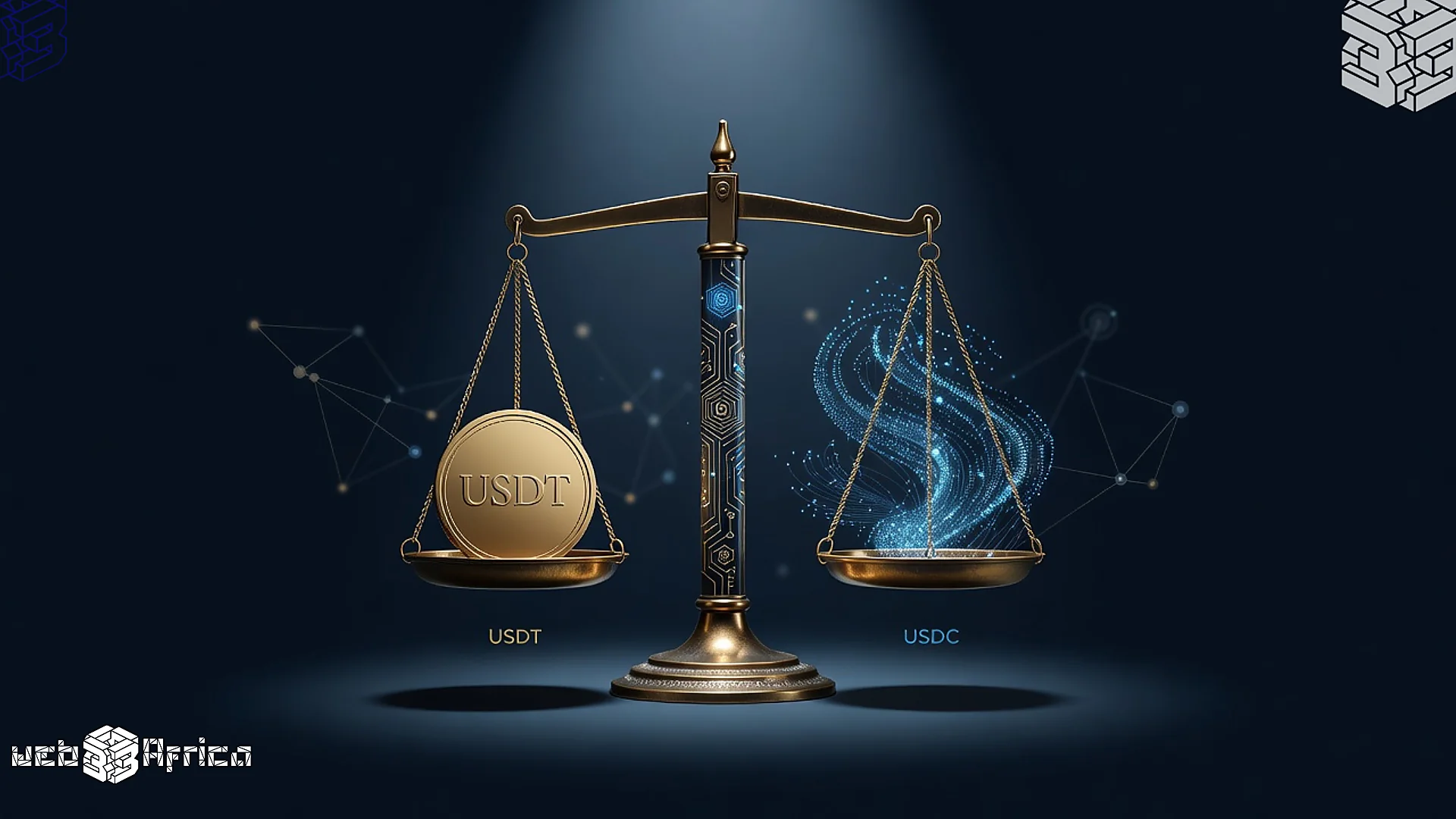
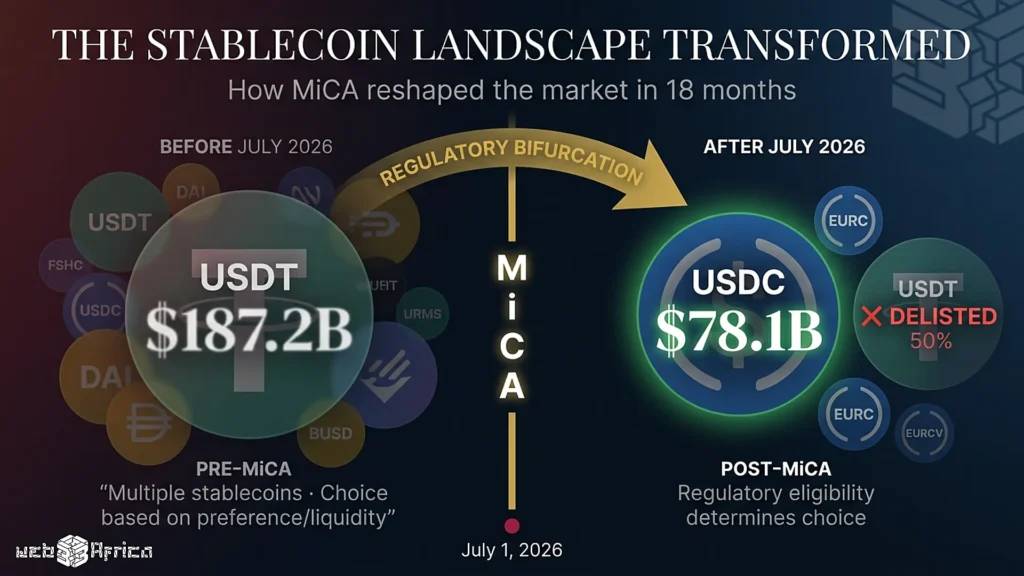
The Markets in Crypto-Assets (MiCA) framework did not ban USDT by name. Instead, European stablecoin regulation defined a rigid compliance structure that offshore issuers simply do not meet.
Under MiCA Article 36, any stablecoin offered to the public or traded on an EU-licensed exchange must meet strict requirements. The issuer must be an EU credit institution or electronic money institution.
Furthermore, reserve backing must be held 1:1 in highly liquid assets, with at least 30% held securely in credit institution deposits (a figure that rises to 60% for tokens classified as “significant”).
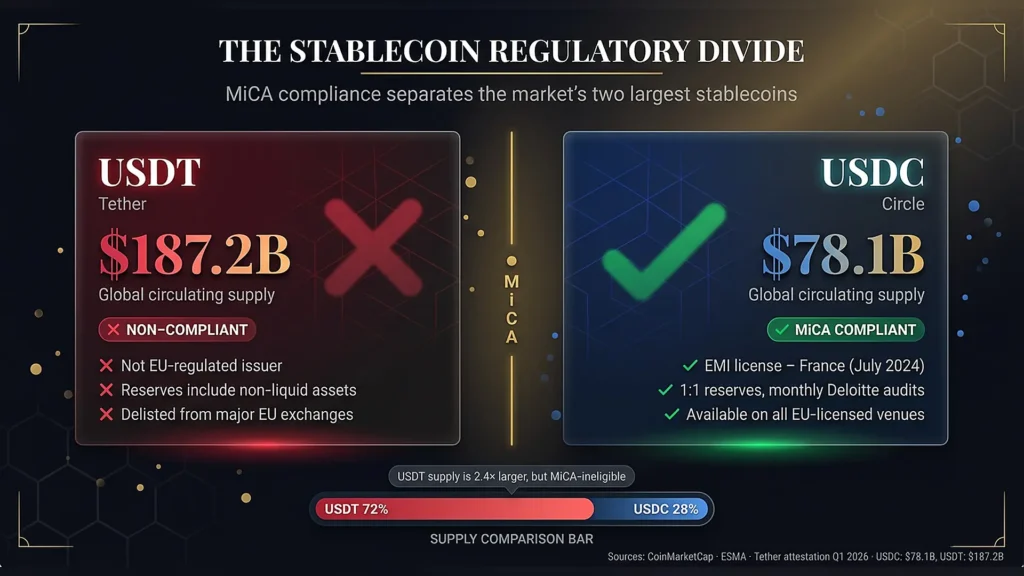
Circle’s USDC and EURC meet these stringent requirements. Circle Mint Europe SAS received an Electronic Money Institution license in France in July 2024. Conversely, Tether’s issuing entities are not EU-regulated, and its reserves include a mix of assets that do not align with MiCA authorization requirements.
RELATED: Circle Gateway Arrives on Mainnet with Blockradar as Day 1 Partner
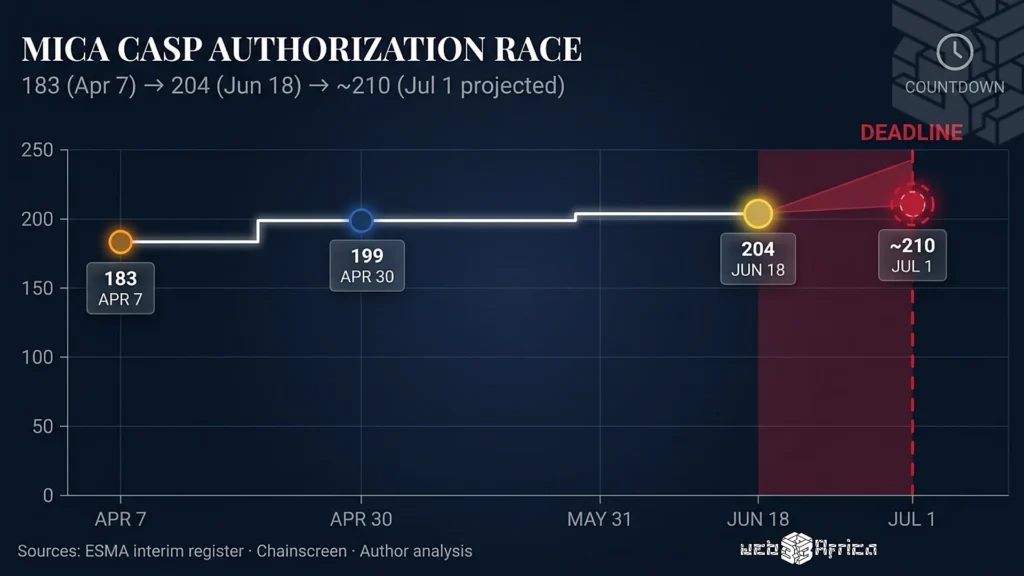
As a result, MiCA-authorized crypto-asset service providers (CASPs) face intense legal pressure to drop non-compliant assets. By April 2026, only 199 CASPs had secured authorization across 23 EU member states. The European Securities and Markets Authority (ESMA) confirmed that after July 1, 2026, serving EU clients without a license constitutes a breach of EU law.
This creates a challenging operational boundary. When evaluating the best stablecoin for business payments into or out of Europe, the choice is no longer determined by user preference or raw liquidity but by regulatory eligibility.
The Operational Impact on Africa-Europe Payment Corridors
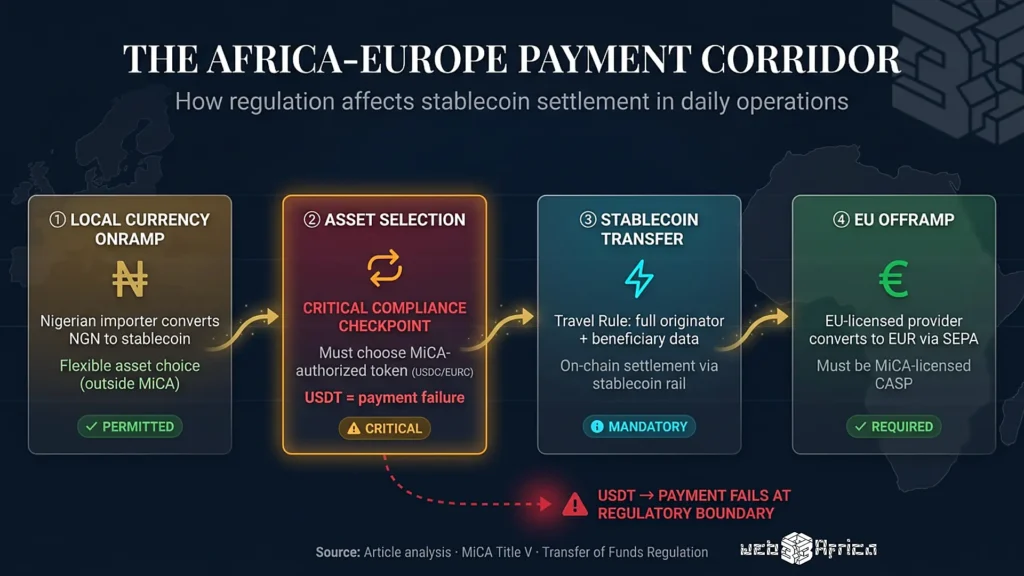
To see exactly how regulation affects stablecoin settlement, consider the step-by-step journey for an African importer paying a European supplier post-July 1, 2026:
- Local currency onramp: A Nigerian importer converts naira to a stablecoin via a local exchange. At this stage, Nigeria operates outside MiCA’s perimeter, allowing flexibility in asset choice.
- Asset selection decision: The importer must decide which token to route to the EU. This is the critical compliance checkpoint. If the German supplier’s licensed exchange cannot process USDT under MiCA law, the importer must switch to USDC, EURC, or another MiCA-authorized token.
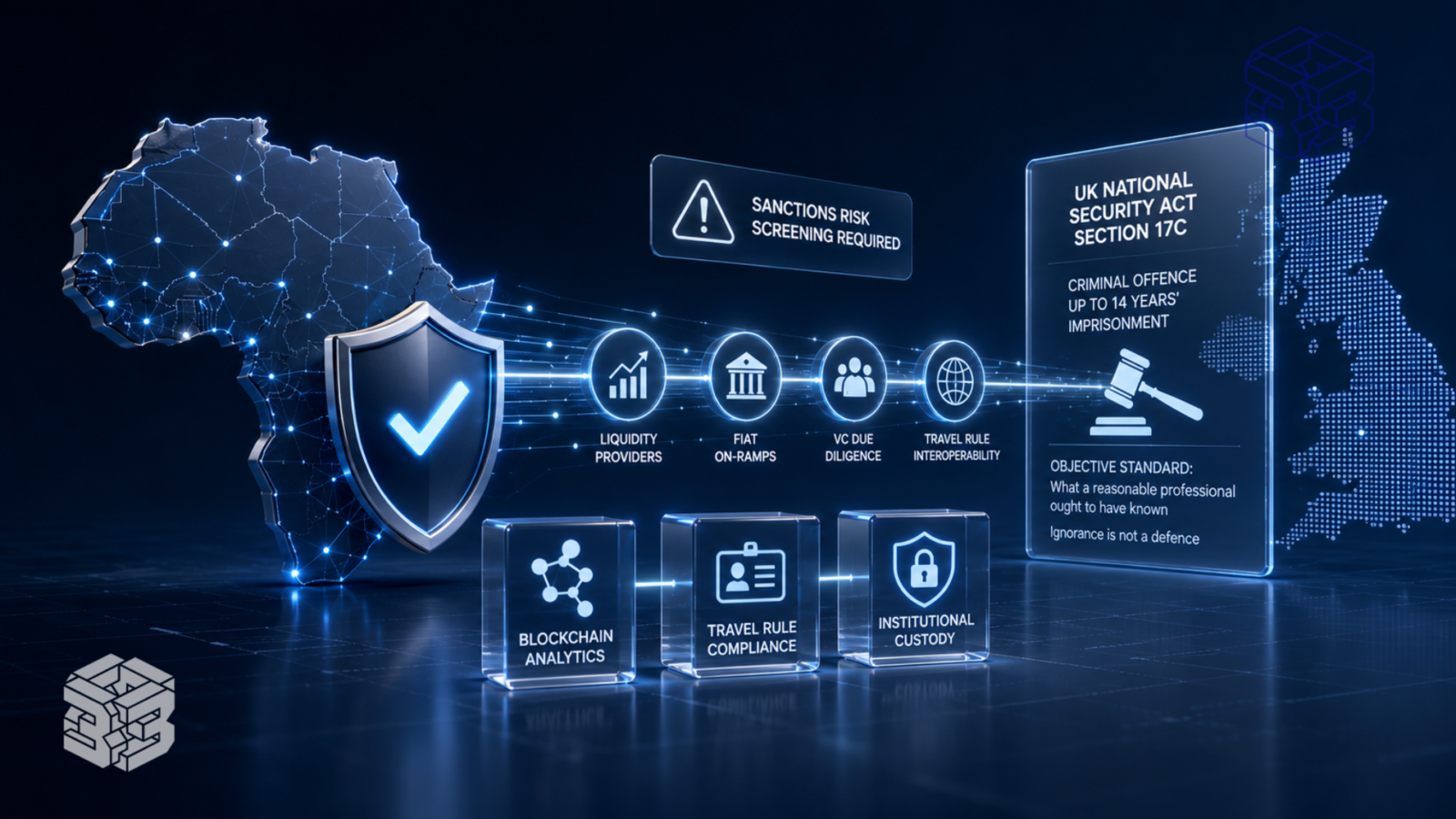
- Transfer via stablecoin rail: The importer sends the funds to a payment infrastructure provider. At this stage, the EU’s Transfer of Funds Regulation mandates the transmission of full originator and beneficiary data to comply with the Travel Rule.
- EU offramp: The EU-licensed provider converts the stablecoin to euros via SEPA. Unlicensed providers cannot legally accept or convert stablecoins for EU clients.
If the importer uses an unauthorized token at step two, the EU-licensed offramp cannot process it without violating MiCA Title V. The payment fails at the regulatory boundary, proving exactly how regulation affects stablecoin settlement in daily corporate operations.
RELATED: African Fintechs in the Crosshairs of Europe’s MiCA Compliance Deadline
Evaluating the Best Stablecoin for Business Payments in a Regulated Environment
This regulatory bifurcation forces an entirely new corporate evaluation framework. Treasury teams executing stablecoin payments in Africa can no longer select assets based solely on familiarity. To identify the best stablecoin for business payments, five operational criteria now matter:
- Compliance posture: Is the stablecoin authorized under the framework governing your counterparty’s jurisdiction? For EU-touching flows, treasuries must verify assets against the ESMA MiCA registry.
- Liquidity depth: Can you convert large amounts without significant slippage? While USDT dominates global liquidity with roughly $187.2 billion in supply, USDC provides a $78.1 billion supply and deeper liquidity on regulated institutional venues.
- Accessibility on trusted venues: Which licensed exchanges support the token? USDC is available on all MiCA-licensed EU venues, while USDT has been broadly delisted for EEA users.
- Fiat conversion ease: USDC benefits from direct SEPA integration via institutional partnerships. Meanwhile, USDT dominates localized stablecoin payments in Africa through deep Tron-based mobile money integrations.
- Settlement reliability: Are reserves audited, segregated, and redeemable at par? Circle publishes monthly attestations via Deloitte, providing the transparency that conservative enterprise CFOs demand when selecting the best stablecoin for business payments. Tether publishes quarterly attestations via BDO Italia; Q1 2026 showed $189.5 billion in liabilities versus roughly $197 billion in reserves.
Other alternatives are also emerging. Ripple’s RLUSD has seen strong African demand through partnerships with Chipper Cash, VALR, and Absa Bank, though its EU compliance status remains a critical factor to watch.
Meanwhile, euro stablecoins like EURC and Société Générale-FORGE’s EURCV are gaining traction for specific treasury use cases, despite the market cap of euro stablecoins remaining relatively small at roughly €500 million.
The Consolidation of B2B Stablecoin Remittance Solutions
Because international compliance is deeply technical and highly expensive, the infrastructure layer connecting Africa to the global north is rapidly consolidating. For African exchanges and fintechs building b2b stablecoin remittance solutions, counterparty selection is now a critical strategic decision.
A prime example of this consolidation is BVNK. Operating with a MiCA-regulated CASP license out of Malta, BVNK processes a staggering $30 billion in annualized volume. By combining MiCA-compliant crypto services and direct SEPA access, they make it easier for corporate treasuries by removing the need to deal with several middlemen.
RELATED: Nigeria’s AI Debate Has Moved Into Enforcement
In March 2026, Mastercard agreed to acquire BVNK for up to $1.8 billion, mirroring Stripe’s $1.1 billion acquisition of Bridge in 2025.
We also see the impact of stablecoin regulation on emerging startups. YouSend, a remittance provider launched in June 2026, operates entirely on a stablecoin-based infrastructure.
Holding licenses from the UK Financial Conduct Authority, FINTRAC in Canada, and the Central Bank of Nigeria, YouSend’s planned expansion into the EU will legally require MiCA CASP authorization. This makes it one of the clearest real-world examples of how European compliance architecture directly influences the roadmap of global b2b stablecoin remittance solutions.
The Strategic Outlook for African Payment Operators and Corporate Treasuries
The enforcement of global stablecoin regulation does not eliminate digital dollars from African payment flows. Instead, it segments them.
African payment operators and fintech builders navigating this bifurcation must now make three fundamental operational decisions:
- Asset strategy: Operating b2b stablecoin remittance solutions increasingly requires a dual-asset treasury structure. Platforms must support USDT for domestic flows where low fees dominate while maintaining specific USDC or EURC routing corridors for transactions touching the European Economic Area.
- Counterparty verification: African businesses must proactively verify their European liquidity providers against official ESMA registers to prevent trapped funds.
- Travel Rule infrastructure: Platforms facilitating stablecoin payments in Africa must deploy robust data infrastructure capable of appending verified sender and receiver KYC data to every cross-border transaction.
Ultimately, strict stablecoin regulation forces market maturation. Treasuries must evaluate digital assets not as interchangeable tokens but as differentiated financial instruments with distinct legal footprints.
RELATED: Stablecoins in Hyperinflationary Markets: A Survival Guide for African Entrepreneurs
As the regulatory net tightens globally, understanding exactly how regulation affects stablecoin settlement is no longer a job just for legal teams. It is the defining operational mandate for any African enterprise seeking to preserve its access to frictionless, cross-border global liquidity.
African payment operators, treasury managers, and fintech builders navigating this bifurcation must now evaluate stablecoins as more than interchangeable digital dollars. Currently, stablecoins are differentiated settlement instruments with distinct regulatory footprints, liquidity profiles, and counterparty access. Operational readiness, dual-asset strategies, verified CASP relationships, and Travel Rule integration matter more than asset preference.
Discover more from Web3Africa
Subscribe to get the latest posts sent to your email.
You must be logged in to post a comment.