









Table of Contents
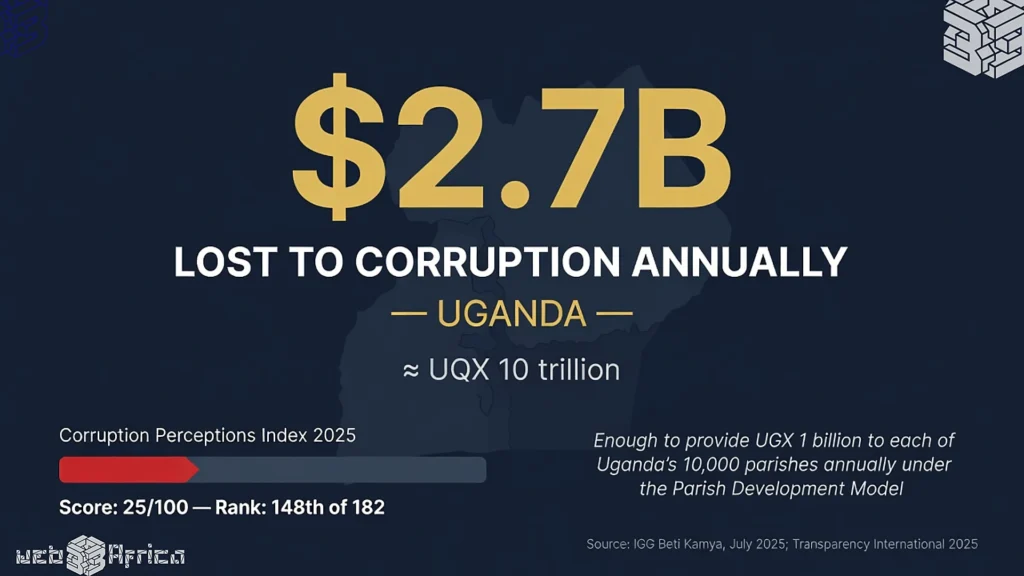
Every year, corruption drains approximately $2.7 billion from Uganda’s economy, roughly UGX 9.14 trillion. This issue compounds year after year, creating a development deficit that becomes increasingly difficult to overcome and never reaches roads, hospitals, or power grids.
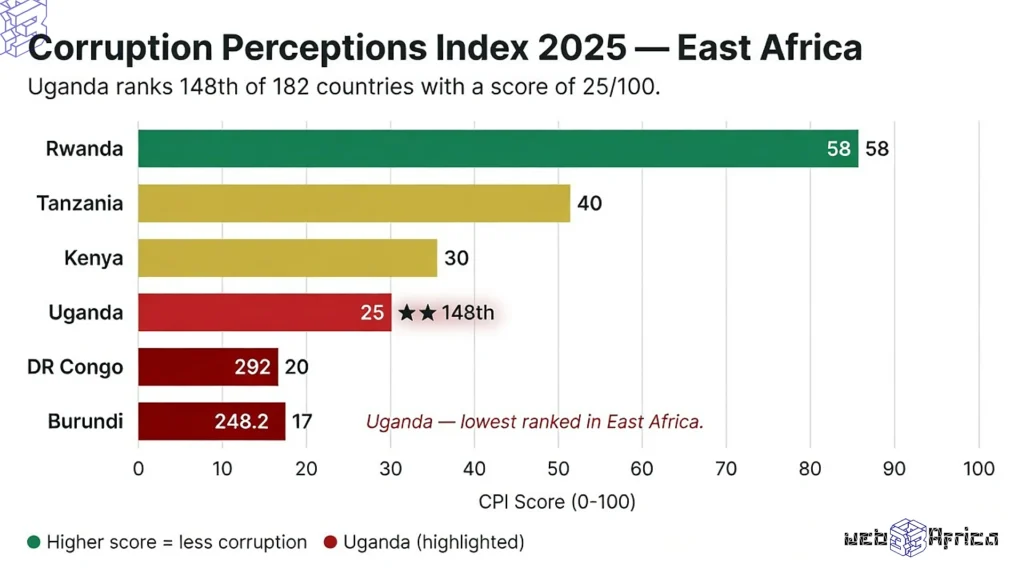
The country ranks 148th out of 182 nations on Transparency International’s 2025 Corruption Perceptions Index, with a score of 25 out of 100. These figures, or more appropriately facts, are more than governance failure; they’re an existential risk.
A $5.5 billion partnership between Global Settlement Network and Diacente Group aims to tokenize infrastructure assets in Uganda’s Karamoja Green Industrial and Special Economic Zone.
The project utilizes blockchain transparency and a pilot central bank digital currency to enable real-time monitoring of budgets and payments, and attract global investment to the region’s agro-processing, mining, and renewable energy sectors.
RELATED: How blockchain privacy failures threaten enterprise payments in Africa
Every solar panel installed, every dollar disbursed, and every contractor payment is recorded on an immutable ledger that investors can audit from anywhere in the world. That is the core promise of blockchain transparency.
It’s a compelling vision. But can blockchain transparency actually deliver on the promise of corruption reduction, or does it simply move the problem from spreadsheets to smart contracts?
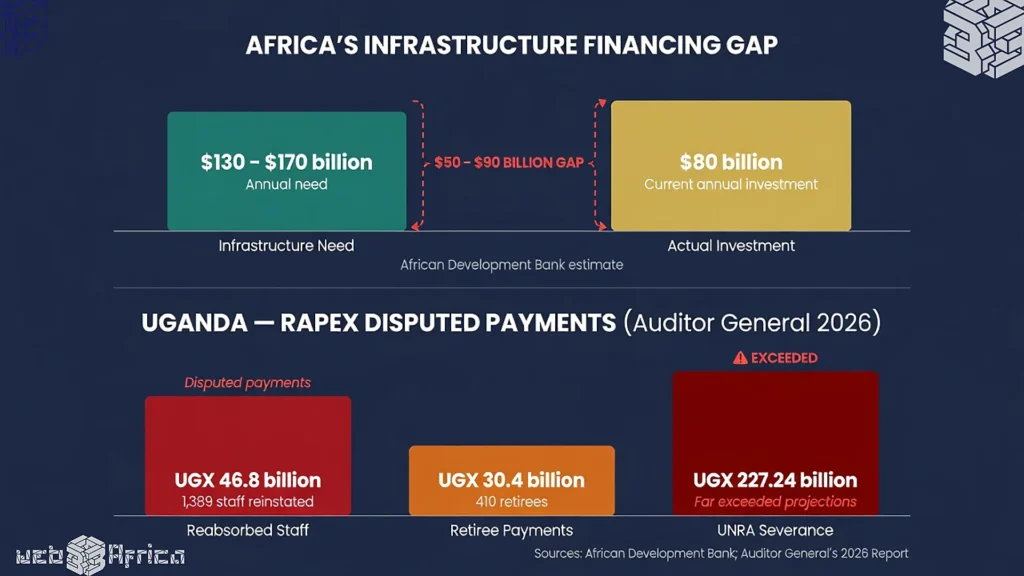
But it’s more than Uganda’s problem. Africa faces an annual infrastructure financing gap of $50 to $90 billion, according to the African Development Bank. Corruption is repeatedly cited as a primary barrier to closing that gap. If blockchain transparency can genuinely reduce corruption risk, it could unlock billions in investment. If it can’t, it risks becoming another technology solution to a fundamentally political problem.
The Infrastructure-Corruption Trap
The relationship between corruption and infrastructure investment in Africa is well documented and brutally circular. Investors avoid markets perceived as corrupt. The absence of investment deepens infrastructure deficits. Deteriorating infrastructure reduces economic growth. Reduced growth limits government revenue for enforcement and institutional capacity. Weak institutions enable more corruption.
The Auditor General’s 2026 report shows UGX 46.8 billion in disputed payments to reinstated staff and UGX 30.4 billion to retirees as part of the government’s RAPEX reform program, along with major issues in managing assets and unpaid debts over UGX 900 billion in the affected agencies. These are hospitals unbuilt, roads unpaved, and power lines never strung.
The World Bank estimates that infrastructure gaps cost African economies up to 2% of GDP annually in lost growth. For a country like Uganda, that compounds year after year, creating a development deficit that becomes harder to escape.
Traditional anti-corruption system measures, audits, oversight bodies, and transparency laws have shown limited effectiveness. Uganda has an Inspector General of Government, parliamentary oversight committees, and civil society watchdogs.
Corruption persists.
As Cissy Kagaba, Executive Director of the Anti-Corruption Coalition Uganda, observed:
“Technology alone fails if political will is missing. Selective enforcement is the real bottleneck.”
This is the context in which blockchain transparency solutions have emerged, offering a new layer of accountability.
How Blockchain Transparency Works
Blockchain transparency operates through three core mechanisms: immutability, auditability, and disintermediation.
Immutability Locks In Trust
Means that once a transaction is recorded on the blockchain, it cannot be altered or deleted without leaving a visible trace. In infrastructure financing, blockchain transparency creates a permanent record of fund flows. If a contract allocates $10 million for road construction and only $6 million reaches the contractor, the discrepancy is permanently visible on the ledger.
RELATED: Blockchain as a Service Explained: When It Makes Sense (And When to Walk Away)
Auditability Opens the Books
Refers to the ability of authorized participants to view transaction histories in real time. Rather than waiting for quarterly reports or annual audits, investors can monitor spending as it occurs. Blockchain transparency provides this real-time monitoring, reducing information asymmetry, the gap between what project managers know and what funders can verify.
Disintermediation Cuts Out Middlemen
Enables direct, programmatic execution of agreements through smart contracts. If a solar installation contract specifies payment upon verification of completed work, satellite imagery or IoT sensors can trigger payment automatically when conditions are met, reducing opportunities for manual intervention and rent-seeking. This is a clear example of how blockchain reduces corruption at the transaction level.
In theory, these features of blockchain transparency address multiple corruption vectors simultaneously. Procurement fraud becomes harder when all purchases are traceable. Ghost workers disappear when payroll is automated and linked to biometric verification. Budget manipulation becomes visible when all stakeholders can audit the ledger in real time.
But theory and implementation are different problems.
Inside Uganda’s $5.5 Billion Blockchain Infrastructure Project
Global Settlement Network (GSX), a Miami-based blockchain infrastructure provider, announced a partnership with Uganda’s Diacente Group to tokenize $5.5 billion worth of infrastructure assets in the Karamoja Green Industrial and Special Economic Zone (GISEZ).
The project would encompass solar energy, mining, agro-processing, and manufacturing, all recorded on GSX’s permissioned blockchain. Blockchain transparency sits at the heart of this model, combined with real-time monitoring through smart oracles.
The announcement included bold and clickbait claims:
1 million jobs created, $10 billion in annual export potential, and a “digital shilling” central bank digital currency (CBDC) that would provide unprecedented blockchain transparency for infrastructure financing.
Ryan Kirkley, CEO of Global Settlement Holdings, positioned it as a direct response to the failures of previous digital currency efforts in Africa.
“Previous systems failed because they were not linked to real use,” Kirkley stated, referencing Nigeria’s eNaira CBDC, which has struggled with adoption since launching in 2021.
“We are starting with industries, with jobs and production, so people have a reason to use it.”
The technical architecture relies on what GSX describes as real-time monitoring through “smart oracle integration.” This is satellite data from solar installations or weighbridge data from mining operations fed directly into the blockchain, triggering automatic payments or tax remittances when predefined conditions are met.
While it does offer a compelling narrative, we have to consider a few reality checks.
First, the “CBDC” is not actually a central bank digital currency. The digital shilling is described as a “private Ugandan CBDC pilot initiative” undertaken by two private companies. The Bank of Uganda has not issued an official statement endorsing the project or recognizing the digital shilling as sovereign currency.
RELATED: Six Pillars to Power Uganda’s Digital Financial Revolution
This is a private-sector token backed by treasury bonds, operating on a permissioned blockchain controlled by GSX. This token is fundamentally different from a central bank-issued digital currency, which has monetary policy implications.
The distinction matters. Official CBDCs carry sovereign backing and regulatory oversight. Private tokens, even when backed by government securities, remain subject to the commercial viability and governance decisions of the issuing company.
Secondly, the infrastructure is permissioned, not public. GSX operates a permissioned blockchain where the company controls who can validate transactions and access data. This fundamentally limits the blockchain transparency benefits that public blockchains like Bitcoin or Ethereum provide, where anyone can audit the ledger. In a permissioned system controlled by a private company, blockchain transparency exists only to the extent that GSX grants access and only for data that enters the system.
Why the Oracle Problem Creates Garbage Data
The most fundamental limitation of blockchain transparency in infrastructure projects is the “oracle problem.” The main challenge is verifying that off-chain reality aligns with on-chain data.
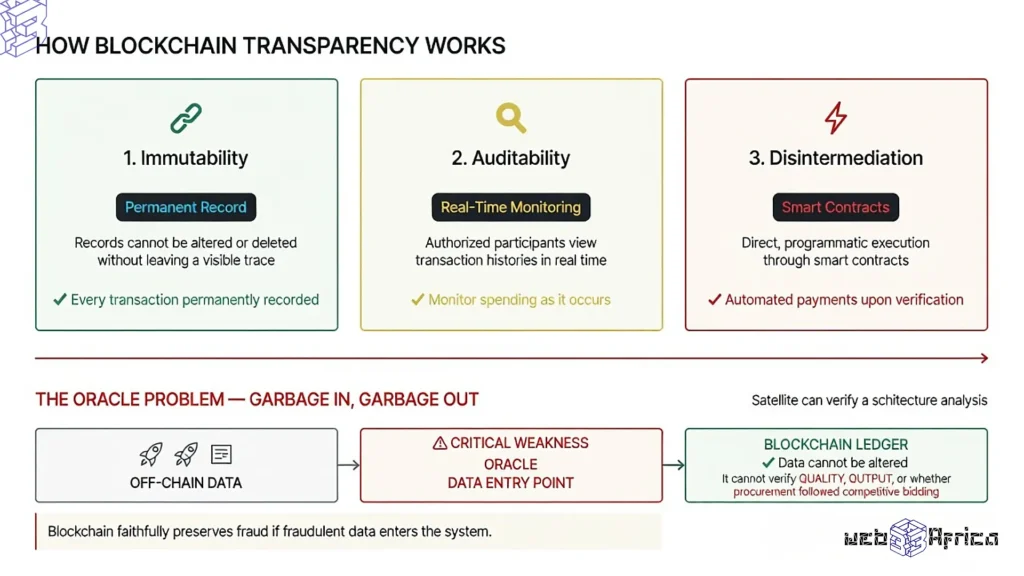
Blockchain ensures that once data is recorded, it cannot be tampered with. But it cannot verify the accuracy of data at the point of entry. GSX’s smart oracle integration, which utilizes satellite imagery and IoT sensors, partially addresses this issue by automating data capture. If a mine operator inputs inflated production figures, the blockchain will faithfully preserve the fraud.
RELATED: How Regulation Is Turning Kenya Into Africa’s Next Blockchain Leader.
GSX’s smart oracle integration, using satellite imagery and IoT sensors, partially addresses the issue by automating data capture. But even satellite verification has limits. Images can verify that a solar installation exists and appears operational. They cannot verify the quality of components, the actual power output, or whether procurement followed competitive bidding processes. This limitation underscores that blockchain transparency alone cannot guarantee integrity without reliable data inputs.
As Yannis Normand discusses blockchain and corporate corruption:
While blockchain can offer substantial benefits in the fight against corruption, it remains a largely untested, novel technology with significant limitations.
With 75% of the population using mobile money but only 17.6 million smartphones in a country of 45 million, meaningful citizen oversight of blockchain transparency remains constrained by digital infrastructure.
If transparency mechanisms are accessible only to foreign investors and government officials, rather than local communities and civil society, the accountability dividend diminishes.
Where Blockchain Succeeds and Where It Fails
Blockchain transparency’s track record in reducing corruption is mixed, context-dependent, and far less proven than proponents suggest.
Georgia’s Land Registry Success Story
In 2025, Georgia partnered with Hedera to move its land and real estate registry onto public blockchain infrastructure. The initiative has provided what officials describe as an “unparalleled level” of data authenticity, eliminating human errors and “the risk of data forgery.”
Property transfer time has been reduced from weeks or months to under one hour. This is a textbook illustration of how blockchain reduces corruption in a targeted, government-led setting.
The main reasons for success are clear: the government took the lead in putting it into action, it uses a public blockchain instead of a private one, it focuses specifically on land registration rather than trying to cover the entire economy, and it has clear results that can be checked by outside parties.
India’s Blockchain Framework in Action
Deployed across permissioned nodes in Bhubaneswar, Pune, and Hyderabad, the framework supports land records, agricultural marketing, and social welfare programs. Research on India’s blockchain initiatives shows “positive associations with clearer audit trails, stronger audit evidence, and stronger fraud prevention.” This real-time monitoring capability demonstrates how blockchain reduces corruption by strengthening audit mechanisms.
This framework, however, comes with a big but: gains are “larger where assurance capability and digital maturity are higher.”
In other words, blockchain transparency amplifies existing institutional capacity rather than substituting for it. Where governance mechanisms are strong, blockchain transparency strengthens them. Where they are weak, blockchain transparency’s impact is limited.
Why Nigeria’s eNaira Fell Short
Launched in October 2021 as Africa’s first CBDC, the eNaira achieved disappointing adoption because it struggled to offer a compelling alternative to existing digital payment options. Limited stakeholder engagement and unclear consumer value proposition undermined uptake.
The Central Bank of Nigeria is now repositioning the eNaira as payment infrastructure for institutions rather than a consumer wallet. This essentially acknowledges that top-down digital currency initiatives fail without organic demand, even when they promise blockchain transparency.
RELATED: How cNGN Cracked the Regulatory Code: A Blueprint for African Stablecoins
On a smaller scale, Mercy Corps Ventures’ stablecoin pilot in Cameroon demonstrated that blockchain transparency can deliver measurable benefits when scope is limited and outcomes are verifiable. The pilot enabled over 900 micro-merchants to move more than $5 million in inventory purchases from Chinese suppliers while reducing transaction costs by 75%, from 15-20% through black market channels to 5-6% via stablecoins.
The difference between these outcomes reveals a pattern. Blockchain transparency succeeds when it addresses a specific, measurable problem (land fraud, cross-border payment costs) with clear success metrics and independent verification. It struggles when deployed as a broad solution to systemic governance failures.
What Blockchain Transparency Alone Cannot Fix
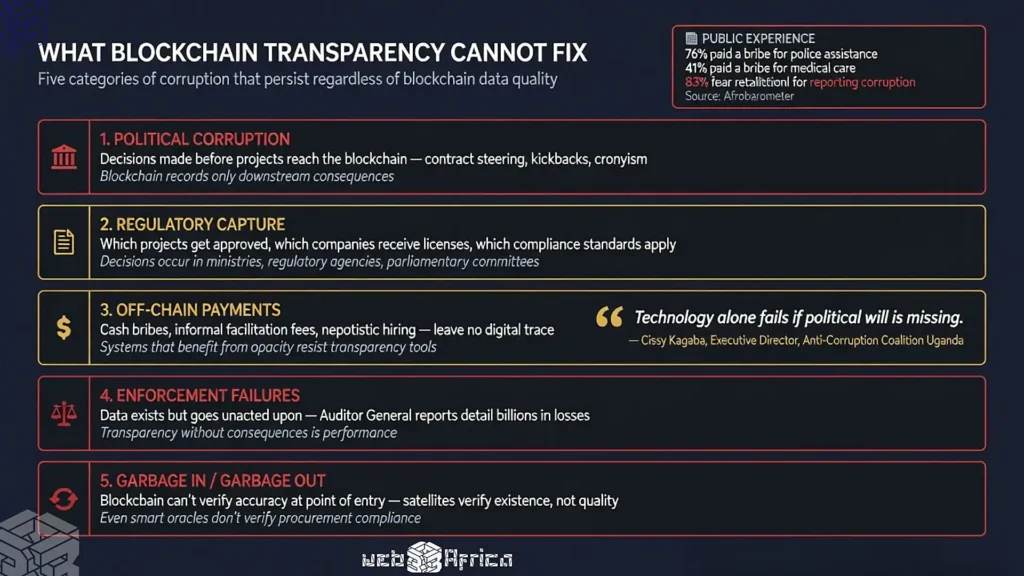
Even perfect blockchain transparency cannot address several categories of corruption in infrastructure projects.
Political corruption occurs before projects reach the blockchain. If a government official steers a contract to a preferred bidder in exchange for kickbacks, such an action constitutes political corruption.
If someone falsifies an environmental impact assessment to approve a politically connected project, blockchain records only the downstream consequences, not the corrupt decision itself. Blockchain transparency cannot retroactively cleanse a crooked selection process.
Regulatory capture shapes which projects get approved, which companies receive licenses, and which compliance standards apply. These decisions occur in ministries, regulatory agencies, and parliamentary committees, spaces where blockchain transparency has no visibility.
Off-chain payments, cash bribes, informal facilitation fees, and nepotistic hiring leave no digital trace. As one academic analysis observed:
“Blockchain may not be favorable in African bureaucracy as it transforms the status quo in the process of eradicating grounds for rampant corruption.”
The implication is that systems benefiting from opacity may resist blockchain transparency tools, creating political rather than technical barriers to adoption.
Enforcement failures persist regardless of data quality. Uganda’s Auditor General produces detailed reports documenting billions in losses. Transparency International publishes annual corruption rankings. Civil society organizations issue investigative reports.
RELATED: How Digital Dollarization and Real World Assets Are Rewiring the Entire Crypto Market
The problem is not lack of information; it is selective enforcement. As Cissy Kagaba of the Anti-Corruption Coalition Uganda stated:
“Technology alone fails if political will is missing.”
This suggests that blockchain transparency functions as an amplifier of existing governance capacity, not a substitute for it.
In contexts with strong institutions and enforcement mechanisms, blockchain transparency can make monitoring more efficient and fraud more difficult. In contexts where corruption is systemic and enforcement is selective, blockchain transparency may simply create more data that goes unacted upon.
The Trade-Off Between Permissioned and Public Blockchains
The Uganda project’s use of permissioned blockchain infrastructure highlights a fundamental tension in anti-corruption system design. Blockchain transparency requires a careful balance between control and openness.
Permissioned blockchains offer advantages for infrastructure projects. They have faster transaction speeds, lower costs, privacy for sensitive commercial data, and compliance with data protection regulations. They also enable GSX to meet “full KYC/AML protocols” and “adhere to both local and international compliance standards,” as the company states.
But permissioned blockchains sacrifice the core blockchain transparency benefit that public blockchains provide: open auditability. On Bitcoin or Ethereum, anyone can run a node and verify the entire transaction history. On GSX’s permissioned network, only authorized participants can validate transactions and access data, which curtails how blockchain reduces corruption through public scrutiny.
RELATED: The Unseen Infrastructure Powering the SoFiUSD Token Launch
This creates a centralization risk. If GSX controls who can audit the ledger, blockchain transparency exists at GSX’s discretion. If the company fails financially, if it faces regulatory pressure to restrict access, or if it decides to modify the protocol, the blockchain transparency infrastructure could be compromised.
Georgia’s land registry chose public blockchain specifically to maximize blockchain transparency. GSX chose a permissioned blockchain to maximize control and regulatory compliance. These are defensible trade-offs with different risk profiles. However, only if stakeholders understand which model is being implemented and what that means for accountability.
What Genuine Transparency Really Demands
For blockchain transparency to meaningfully reduce corruption in Africa, several conditions would need to be met, most of which extend beyond the technology itself.
Independent Data Verification at Entry
Smart oracles using satellite imagery, IoT sensors, and third-party auditors could reduce (though not eliminate) the garbage-in-garbage-out problem. The key is ensuring that data verification is genuinely independent, not controlled by the same actors responsible for project implementation. This is an essential component of any anti-corruption system built on blockchain transparency.
Open Source Smart Contract Code
If payment triggers, budget allocations, and compliance checks are encoded in smart contracts, that code should be publicly auditable. Private, proprietary smart contracts defeat the blockchain transparency purpose.
Multi-Stakeholder Governance
If blockchain validators are solely GSX employees or government appointees, the system is vulnerable to collusion. Genuine blockchain transparency would require civil society organizations, independent auditors, and community representatives to participate in validation and oversight.
Enforcement Mechanisms That Bite
Transparency without consequences is performance. If blockchain transparency data reveals budget discrepancies, procurement fraud, or contract violations, there must be clear, enforced penalties. This requires functional judicial systems, independent anti-corruption bodies, and political will, none of which blockchain transparency can create on its own.
Accessible to the Public
If blockchain transparency tools are accessible only through expensive software, require technical expertise, or are available only in English, they serve foreign investors but not local communities. True accountability requires that the people affected by infrastructure projects can monitor their implementation.
Building Capacity to Interpret Data
Raw transaction data is not self-explanatory. Civil society organizations, journalists, and oversight bodies need training and resources to interpret blockchain transparency data, identify anomalies, and translate findings into advocacy and enforcement actions.
These conditions are technically feasible but politically and institutionally demanding. They require investment not just in blockchain infrastructure but in the full ecosystem of governance, enforcement, and civil society capacity. Press releases announcing multi-billion-dollar tokenization projects rarely mention that investment, even though blockchain transparency and a functioning anti-corruption system go hand in hand.
Can the Blockchain Transparency Dividend Be Realized?
Bitange Ndemo, professor and former Kenyan ambassador, captured this nuance:
“Blockchain provides immutable ledgers, but the killer benefit is reducing ‘tenderpreneur’ interference.”
This refers to contractors who are politically connected and win bids based on their relationships rather than through competitive merit.
However, even imperfect blockchain transparency represents an improvement over the opacity that currently prevails. If blockchain-based systems enable earlier detection of problems, faster audits, and clearer documentation of fund flows, they reduce risk and potentially lower the cost of capital. That, in turn, could expand the volume of infrastructure investment willing to enter markets like Uganda.
If workers are paid in digital shillings, suppliers accept them for inputs, and taxes can be remitted in the same currency, a virtuous cycle of adoption could emerge, powered by blockchain transparency and real-time monitoring.
But “could” is not “will.”
The $125 million in committed settlement liquidity “remains parked and unused,” according to GSX’s own reporting. Kirkley stated that deployment is “zero” because the company is “still forming its market maker entity.”
The AKIBA International acquisition that would provide licensed exchange infrastructure is “pending regulatory approvals.” The entire initiative remains in a sandbox phase, testing, and not operating at scale.
Blockchain transparency can help manufacture trust, but only when we design the incentives, oversight, and verification systems to make corruption expensive rather than merely traceable. In the end, that is how blockchain reduces corruption—by turning opaque systems inside out and making accountability a permanent, public feature of every transaction.
FAQ
How does blockchain transparency help reduce corruption?
Blockchain transparency creates immutable transaction records, enables real-time monitoring and improves auditability, making infrastructure spending easier to track and verify.
Can blockchain eliminate corruption on its own?
No. The article concludes that blockchain improves transparency but cannot replace political will, independent enforcement, or strong governance institutions.
Why is Uganda using blockchain for infrastructure projects?
The project aims to improve transparency, monitor infrastructure spending in real time, attract investment and reduce corruption risks through blockchain infrastructure.
What is the oracle problem in blockchain?
Blockchain protects data after it is recorded, but it cannot verify whether information entering the system is accurate. Incorrect data can still become permanently recorded.
Why does the article compare permissioned and public blockchains?
Public blockchains maximize open auditability, while permissioned blockchains provide greater privacy and regulatory control but limit who can independently verify transactions.
Discover more from Web3Africa
Subscribe to get the latest posts sent to your email.

You must be logged in to post a comment.