











TL;DR,
- Nigeria’s central bank officially denied issuing any fake CBN directive targeting crypto exchanges after documents circulated online claiming to freeze accounts linked to digital assets.
- The controversy revealed knowledge gaps in Nigeria’s crypto community, emphasizing the importance of verifying information through official channels rather than social media.
- The real action was a separate, court-approved EFCC investigation into specific forex accounts.
Nigeria’s crypto community has been riled up with recent rumours of a government crackdown on accounts going a far as confiscating funds. The Central Bank of Nigeria (CBN) has officially responded to the allegations regarding a purported directive targeting exchanges, wallets and DeFi platforms. The entire region is particularly focused on the crypto account freeze, with many speculating that it’s more than what it appears.
The Controversy Behind the Alleged Fake CBN Directive
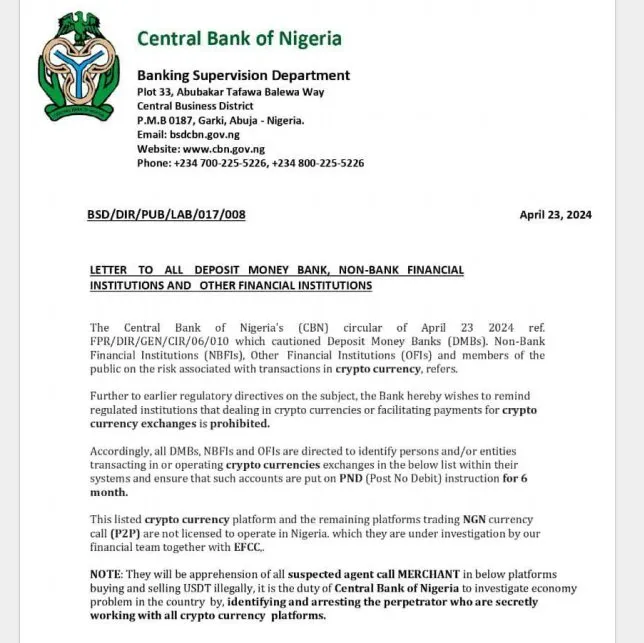
The entire controversy started when documents circulated online, appearing to show official CBN communication to financial institutions. These documents mandated a “Post No Debit” status on accounts linked to digital assets and any crypto-linked systems, effectively preventing any withdrawals.
Nigeria is Africa’s largest crypto community, housing over $59 billion in crypto transactions, and an uproar quickly sparked. Fortunately, the fake CBN directive promptly prompted a response from the central bank denying the authenticity of these documents.
In an official statement, the bank specifically clarified it hadn’t issued a recent CBN directive on digital assets. As per CBN, the entire “crypto accounts freeze” was news to them as well. What made this case particularly interesting is the recent updates to Nigeria’s cryptocurrency regulation in 2023.
RELATED: CBN Deputy Director Explains NFC Integration for Digital Currency
In December 2023, Nigeria’s regulatory powerhouses reiterated their initial crypto ban. Instead of an all-out ban on crypto, guardrails were placed for many financial institutions. It was a massive win since now banks had the green light to maintain relations with Virtual Asset Service Providers within risk-based constraints.
Banks may interface with firms, but are limited by compliance standards. Licensed crypto exchanged that adhered to proper KYC/AML controls and reporting rules were among the few beneficiaries.
Thus, when the documents “reminded” regulated institutions that they were banned from dealing with cryptocurrency, its was rang suspicious bells. What made it even more controversial was a directive to Deposit Money Banks (DMBs), Non-Bank Financial Institutions (NBFIs), and Other Financial Institutions (OFIs) to identify and report all individuals and entities operating or dealing with exchanges.
There are a few speculations as to what fueled the rumor mill. Most attribute it to the EFCC’s recent court-approved actions against 300 forex accounts connected to P2P platforms. According to EFCC Chair Ola Olukoyede, the agency discovered a “worse scheme” than Binance’s recent fiasco. The linked accounts were essentially operating outside the official financial corridors, accumulating over $11 million(15 billion Naira) through a forex platform.
The court-approved actions eerily resemble he fake CBN directive, prompting many stakeholders to believe. Secondly, Nigeria has had a touch-and-go relationship with digital assets. It’s only been four months since the 3-year-long crypto ban was lifted.
Distinguishing Fact from Fiction: No Crypto Accounts Freeze Confirmed
What the fake CBN directive really revealed was the lack of knowledge within Nigeria’s crypto community. Cryptocurrency is a fast-paced domain with many advancements quickly popping up in a matter of months. Policies cannot simply change as fast, and especially via anonymous PDFs.
Social media had a big part to play since most consumers often rely on such platforms for information, disregarding the fact that AI has saturated most platforms. Checking credible updates from official channels and places must be the first go-to option for most. Additionally, “leaks” and polices don’t go together; if an official document isn’t uploaded on the official platform, it probably doesn’t exist either.
Fortunately, the CBN has clarified that no accounts were frozen, and it’s a separate issue from the EFCC, which sought an official court order before taking any action. For users or individual traders, if your bank flags an account is often due to a court order or applying routine risk controls.
RELATED: Binance Nigerian Operations Hit Major Roadblock With Executive Detention.
Nigeria is currently taking the high road when it comes to digital assets. Licensed crypto exchanges have implemented strong controls approved by regulators. While concerns about the Naira’s stability are valid, finding a means to benefit from crypto proves more valuable.
Meanwhile, public communication matters. Rumors of the cascade into panic, forcing many to make decisions they later regret. When messaging explicitly differentiates targeted enforcement from system‑wide policy, confidence improves, and markets remain steady.
The real CBN directive on digital assets was fostering adoption under various risk-preventive measures, not an outright ban.
Discover more from Web3Africa
Subscribe to get the latest posts sent to your email.

You must be logged in to post a comment.