











In Brief
Nigeria Fintech funding is transitioning from a reliance on volatile foreign venture capital to a domestically anchored, guarantee-backed credit model.
The fintech credit guarantee scheme (FCGW) aims to leverage $900 million in private capital by de-risking loans for youth and women-led fintech enterprises.
A refreshed CBN fintech policy now prioritizes “Smart Licensing” and supervisory technology to reduce the 12-month approval bottlenecks cited by 62% of firms.
The recent FATF grey list removal has already triggered a projected 10-15% rise in Foreign Direct Investment by lowering international compliance frictions.
The Central Bank of Nigeria (CBN) had decided to back Nigeria’s fintech boom but only with cheers and policies. The bank has made it clear it doesn’t intend to be the institution that signs venture-style checks.
We previously did a piece on CBN’s latest report, Shaping the Future of Fintech in Nigeria: Innovation, Inclusion, and Integrity, highlighting its general information. However, this article dives into a particular statement the report made.
The CBN placed it plenty; Nigeria’s fintech funding base has been overly exposed to foreign capital cycles and FX volatility. The solution is to build more resilient, domestic funding channels rather than recreate a central bank–run venture fund.
In 2025, Nigeria fintech funding to startups fell 17% to just $343 million, with the country’s share of African venture capital dropping to 11%—the lowest since modern tracking began in 2019. Simultaneously, the CBN’s own history with direct financing interventions, particularly the troubled Anchor Borrowers Programme (ABP), has left regulators wary of repeating past mistakes.
Why the CBN is saying “no” to directly playing a part in Nigeria Fintech Funding
The report shows fintech leaders asked for “better regulation” alongside capital. The CBN’s survey found 87.5% of respondents supported setting up a fintech-specific growth fund or guarantee structure. But the central bank draws a line based on mandate and precedent.
After years of development-style interventions drawing criticism, especially the Anchor Borrowers Programme (ABP), the CBN is distancing itself from direct financing and leaning instead into coordination, blended finance, and credit guarantees.
RELATED: United Front: SEC, CBN, and EFCC Form Alliance to Crush Crypto Scams
ABP is the cautionary tale that makes the “no direct growth fund” decision feel logical. Launched in 2015, ABP ultimately saw the CBN disburse over $819 million (₦1.1 trillion) before it was discontinued in 2023 as the bank refocused on core monetary responsibilities. An auditor-general’s report later indicated the CBN had yet to recover $468 million (₦629.04 billion), nearly 60% of disbursed funds, as of December 31, 2022. This experience fundamentally reshaped the regulator’s philosophy.
So in 2026, the CBN’s posture is “grow—but don’t break the system.”
What fintechs asked for and what the CBN offered instead
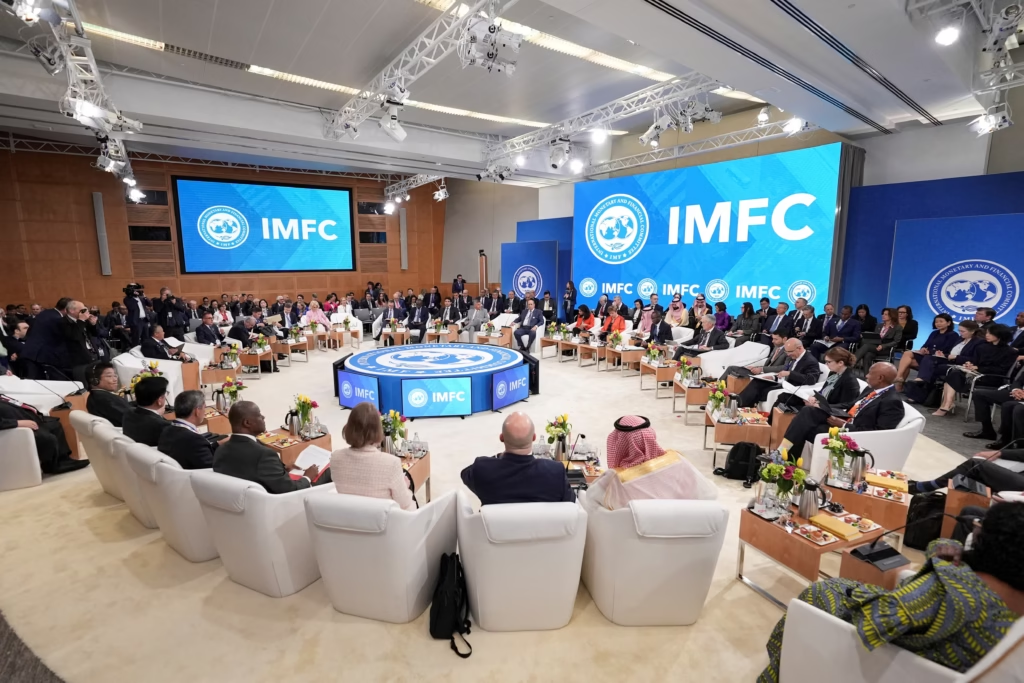
At the October 2025 Fintech Roundtable (held around the IMF-World Bank meetings), executives pushed for a CBN-backed growth fund as the “funding winter” deepened. 87.5% of whom supported creating a fintech credit guarantee scheme or direct growth fund.
The CBN’s response was unequivocal:
“While the CBN cannot directly create venture funds, it can convene stakeholders to structure blended finance… through partners such as the Development Bank of Nigeria (DBN) and InfraCredit.”
This simply means CBN is content acting as a matchmaker, setting rules, aligning development finance institutions (DFIs), and reducing risk so private lenders and domestic capital markets can supply funding.
This is where CBN fintech policy becomes less about speeches and more about plumbing: guarantees, risk-sharing, and market infrastructure that can survive the next global rate cycle.
CBN compliance Department Introduces Proactive Measures Against Financial Crime
The implied “risk stack” and what the CBN is trying to prevent
The report, and the surrounding reforms, signal a layered set of concerns the CBN is trying to manage while fintech adoption accelerates:
Informal Dollarization via Stablecoins
With $22 billion in stablecoin transactions bypassing traditional FX channels, the CBN worries about “FX leakage”—foreign currency flows moving entirely within crypto rails, limiting monetary policy visibility and control.
RELATED: The 2026 Borderless Report on Africa’s Global Execution Spread Premium
AML/CFT Compliance Fatigue
An overwhelming 87.5% of fintech firms reported that Anti-Money Laundering (AML) and Combating the Financing of Terrorism (CFT) compliance costs significantly erode their innovation capacity—a fixed-cost barrier favoring incumbents.
Regulatory Approval Bottlenecks
Over 62.5% of firms cited licensing delays as material constraints, with more than one-third reporting product approval timelines exceeding 12 months—an eternity in fast-moving fintech markets.
Foreign Capital Dependency
Nigeria’s historical reliance on offshore venture capital created vulnerability to global monetary tightening. When US interest rates rose, risk-free returns competed directly with frontier-market venture bets, and capital evaporated.
The “grow with adoption” strategy: what the CBN has already put on the table
Rather than lend directly, the CBN is assembling guardrails and capital-mobilization tools that aim to expand funding without recreating ABP-style risks:
Regulated rails for crypto-adjacent activity (without endorsement): The CBN’s December 22, 2023, VASP banking guidelines reopened bank account access for VASPs under strict conditions, while stressing:
“Banks… are still prohibited from holding, trading, and/or transacting in virtual currencies on their own account.”
Legal clarity for virtual assets via the ISA 2025: The Investments and Securities Act (ISA) 2025 treats virtual assets as securities and places VASPs under SEC oversight, expanding the “white market” for compliant operators.
FX-market tightening to reduce leakage: In February 2026, the CBN granted BDCs limited access to the official FX market ($150k weekly cap) and required full KYC, electronic reporting, and tight reconciliation timelines—measures framed as reducing opacity and spread distortions.
A payments scale-up roadmap: PSV2025 remains the organizing framework in a country where NIBSS Instant Payments processed nearly 11 billion transactions in 2024 (up from 5 billion in 2022).
Implementation roadmap (2026): engagement forums, Open Banking implementation, “smart licensing” scoping, a refreshed sandbox (including AI/RegTech), and a push toward supervisory technology (SupTech).
The core workaround, a fintech credit guarantee scheme, not a CBN-run growth fund
The centerpiece of the alternative capital plan is the proposed Fintech Credit Guarantee Window (FCGW), which the CBN says should be operationalized with DFIs rather than housed as a venture vehicle inside the central bank.
The report’s policy language is explicit:
“Fintech Credit Guarantee Window (FCGW): Design and pilot a blended-finance mechanism to de-risk MSME lending by eligible fintechs.”
This approach uses guarantees to absorb a portion of lender losses if borrowers default. This encourages banks and other financiers to extend longer-term, local-currency credit to fintechs (or to the MSME portfolios fintechs originate). The Development Bank of Nigeria (DBN) and its subsidiary, Impact Credit Guarantee Limited (ICGL), are positioned as key operators.
A major adjacent catalyst is the World Bank–approved FINCLUDE project (December 2025): a $500 million package, with a de-risking component allocating a leveraged $900 million for guarantee activity via ICGL, including support for priority segments such as women-led enterprises.
Sovereign capital is coming—but through different pipes.
Even as the CBN refuses to “venture,” Nigeria is not stepping away from public capital altogether. The iDICE digital investment program—a $617.7 million initiative launched in 2023 with backing from the Federal Government, AfDB, AFD, and IsDB—signals a separate, professionally managed route for public participation in innovation finance.
Stakeholders are also discussing secondary-market liquidity for fintech debt instruments, leaning on existing market infrastructure like FMDQ and NASD (with InfraCredit guarantees often cited as proof-of-concept for crowding in pension and institutional funds).
Why this matters now: confidence, cross-border flows, and the post-grey-list moment
Nigeria’s FATF grey list removal on October 24, 2025, reduces the compliance penalty attached to cross-border transactions and can help restore correspondent banking relationships, important for remittances and global partnerships. With remittance inflows estimated at $21.2 billion in 2023, even marginal reductions in friction and settlement delays can have meaningful real-economy effects.
RELATED: The African Crypto Code: Regulating Digital Currency Across Borders
What this means for founders, banks, and investors
Founders: Plan for credit-enabled growth, not VC-only growth. Prepare audited financials, tighter risk models, and bankable reporting so you can qualify for guarantee-backed facilities.
Banks and DFIs: expect pressure (and incentives) to expand SME/fintech-linked lending under partial guarantees—while keeping “skin in the game” to avoid ABP-style moral hazard.
Investors: Watch for structures that turn fintech receivables into financeable assets (warehouse lines, forward-flow deals, and guaranteed notes) and for improved risk pricing post-FATF delisting.
Coordination Over Cash
The CBN approach to Nigeria fintech funding has shifted from direct intervention to coordinated facilitation. It’s leveraging credit guarantees through DBN/ICGL, anchoring sovereign capital via iDICE, and integrating stablecoins through CBN fintech policy frameworks rather than banning them. The regulator is attempting to build a more resilient, domestically anchored funding base.
Success depends on execution speed. With 62.5% of firms identifying 12-month+ approval timelines as barriers and 87.5% demanding guarantee mechanisms, the operationalization of the fintech credit guarantee scheme in the coming quarters will determine whether Nigeria transitions from fintech frontrunner to fintech rule-setter or whether capital and talent continue migrating to jurisdictions with faster, simpler access to growth capital.
The message from Abuja is unambiguous: Nigeria will support fintech growth, but on terms that avoid the costly mistakes of the Anchor Borrowers era: guarantees, not grants; matchmaking, not venture capital.
FAQ Scheme
Why is the CBN shifting away from direct Nigeria Fintech funding?
The Central Bank of Nigeria is moving away from direct funding models like the Anchor Borrowers Programme (ABP) due to high default rates and a desire to refocus on core monetary stability. Instead of signing venture checks, the bank’s new strategy emphasizes “market plumbing”—creating regulatory frameworks and credit guarantees that encourage private and development capital to flow into the ecosystem.
What is the new fintech credit guarantee scheme in Nigeria?
The fintech credit guarantee scheme, officially titled the Fintech Credit Guarantee Window (FCGW), is a blended-finance mechanism designed to de-risk lending to fintech-originated MSME portfolios. It is piloted by the Development Bank of Nigeria (DBN) and its subsidiary, Impact Credit Guarantee Limited, leveraging a $900 million guarantee component from the World Bank’s FINCLUDE project to catalyze local currency lending.
How does the FATF grey list removal affect Nigerian fintechs?
Nigeria’s removal from the FATF grey list on October 24, 2025, serves as a massive reputational catalyst. It reduces the compliance “tax” on cross-border transactions, restores international confidence, and allows fintech firms to renegotiate correspondent banking relationships with global partners, which is essential for scaling remittance and trade finance services.
What role does the Development Bank of Nigeria play in fintech growth?
The Development Bank of Nigeria fintech initiatives focus on institutional de-risking rather than direct equity. Through the FINCLUDE project, DBN provides long-term wholesale funding and partial credit guarantees to eligible fintechs, enabling them to offer more affordable, longer-term credit to underserved segments like women-led enterprises and agribusinesses.
Related Reading:
- After Years of Chasing Crypto Fraud, Kenya Is Trying Something Different
- Forcing the Blockchain to Report and the Future of South African Digital Taxation
Discover more from Web3Africa
Subscribe to get the latest posts sent to your email.
You must be logged in to post a comment.